This year, I am so excited to be participating in the Doc Accelerator program at the 2013 Hot Docs Film Festival!*

Yesterday was the first day of workshops, however, as part of the program we received full industry passes to the festival. I attended the opening night film, the Manor, and have seen 12 films over the first weekend.

I have made a viewing schedule of about 40 films, and over the course of the weekend I have realized that, so far, each day has had a theme(ish). Below are some of my thoughts on a few of the films I have seen, and links to each film’s synopsis and trailer.

Day 1: The Future

The first film I saw was the Human Scale, which studies urbanization and the development of cities. An interesting question posed by the film was, if cities were planned to accommodate the growing infatuation with the development of the personal car, does city planning take into consideration human interaction, happiness, community, and intimacy?

Historically speaking, we lived in clans and tribes, and now it is common for households to be no larger than two or three people, and even more common to see single-person households. This film addresses this changing environment, and asks if a population can learn how to care for one another in an environment that does not allow them to do so or provide the space necessary to foster these relationships. Environmental considerations in addition to economic interests are revealed in the city-planning in Bangladesh and in Christchurch, New Zealand, which is contrasted with cities like Copenhagen and Vienna that are constructed to accommodate bicycles and public life. Even New York City received a makeover of Times Square, which created a pedestrian-friendly space in the heart of an individualistic community.

In the context of China, the film asks us to think about how we deal with the steady influx of people to a city centre. As more people migrate to urban communities, the film argues for attention, time, and efforts to be focused on creating a community that has a positive social development, in addition to being economically and environmentally sustainable. The unfortunate hurdle, albeit obvious, is that of the need to readily satisfy the political interests of providing solutions now, with little thought. It is scary to think of how much these interests impact not only the environment, but also our quality of life, and even our understandings of what makes a ‘good life.’

I also saw Terms and Conditions May Apply, which focuses on what personal information is being given up by technology users to parent companies, and how this information is being used.  I finished the day with a viewing of I Am Breathing, which followed the final days of a man living with Motor Neurone Disease, and what he wants to leave behind for his young son.

Day Two: Exploitation, and Death

I started off the day with a viewing of Who Is Dayani Cristal? which traces the forensic investigations of the identification of South American migrants’ bodies found on the American side of the America-Mexico border. One body in particular, which has “Dayani Cristal” tattooed across the chest, is used as a narrative to guide the reenactment of the dangerous journey migrants make to seek employment in the United States. This film was the best film I have seen that mediates the production use of a personal story to illustrate a larger social issue.

Next, I saw Valentine Road, which follows the trial of the murder of Larry King, a high school student who was shot in the head by a boy who Larry had asked to be his Valentine. This film was not the first movie to make me cry, but it was the first to touch me in the way the Bully Project did two years ago.

I went from Valentine Road, where I found it hard to have sympathy for the convicted murderer, to In the Shadow of the Sun, which portrays the violence facing albino people in Tanzania. The main character, Josephat, an albino man, preaches forgiveness as evil comes from a place of ignorance. In the Q&A, he argued that we must “find the place where this is starting,” which I later thought about in the context of the Larry King case.

I followed this film with the Exhibition, a film that showcased the art installation by a Vancouver-based artist that presented portraits of the murder victims from the Pickton case, and other missing and murdered women. This show received a lot of resistance from women’s and Aboriginal organizations, who argued that the artist was exploiting these stories and unjustly serving as a “voice” for these women.

After a day of difficult topics, I ended the night with a late-night screening of Furever, a documentary which looks at the lengths some people will go to commemorate their pets once they have died. It was both hilarious and shocking, including people who have their pet’s ashes mixed in with tattoo ink, those who have mummified their pets, and even had them cloned.

Day 3: Poverty

This day started off with a screening of The Only Son, which follows a man’s journey back to his remote village in Nepal (which took two small planes and a 10-day hike into the mountains to get to), to see his parents who want him to return home to take care of them, their land, and be married to a local girl. Caught between a tension to continue the western life he has become accustomed to, and honouring his parent’s wishes and values, the main character and his siblings struggle to decide whether or not they will stay.

Then I saw Tough Bond, which was one of my top choices for this year’s festival, largely because I have a personal affinity to Kenya. This documentary analyzed the poverty of tribal and urban communities, in which children have taken to huffing glue as means to survive each day. I loved the cinematography of the rural communities, and the characters and their stories were well developed. However, the Q&A left me with many questions about the filmmakers’ intentions. While I did not get the chance to ask them any follow-up questions, I did feel like many of their projects to “help” the community smelled a bit of white saviour complex, neo-colonialism, and western imperialism. For example, one of the projects they are hoping to do is build a radio station that will work with tribal communities to create cultural archives. I am wary that the editing of such material, if done by the filmmakers, may unavoidably inscribe western values to it. However, one of the great points raised by the filmmakers was the tendency to only view children as children if they are in a school uniform, rendering children in tribal communities and children in urban slums invisible.

Next I saw Tales From the Organ Trade, which analyzed the growing illegal trafficking of organs, in which people living in poverty are selling their organs to wealthy westerners, raising questions about consent, exploitation, and human value.

I finished the weekend with Remote Area Medical, which reveals the inadequate access to health care in the United States. This was both sad and inspirational. The Q&A afterwards was particularly compelling, as one audience member questioned the interests of the people using this pop-up service, as southern states (this RAM pop-up took place in Tennessee), tend to vote Republican, a party that opposes universal public health care.

I am so excited for today’s workshops and films, and will continue to update with my thoughts and picks from the festival!

Continue reading

On March 8th, I had the honour of being part of a panel at Carleton University as part of their International Women’s Day celebration. I was one of five experts talking about media, representation, and gender. Hopefully I’ll be able to upload a video soon of the discussion, but until then I have put my notes below!

Image

My friend Dom (left) and I (right) with the panel’s moderator, MTV’s Aliya-Jasmine Sovani.

The topic of media representation of women can be quite abstract. Can you offer some concrete examples of the impact media misrepresentations have on people’s daily lives?


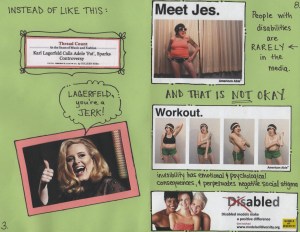
Media representation has a huge impact on our lives, both directly and indirectly. We all operate within these systems. Engaging in consumerism through the media’s regulation of gender is probably the most obvious response. This includes deciding which cosmetics to buy, how we approach “taboo” subjects like menstruation, to how we value skin colour through the advertisement of band-aids and skin care products. Less overtly is how the media perpetuates discrimination and oppression through the maintenance and reinforcement of harmful stereotypes. The media places limitations on everyone’s bodies and capabilities, especially women who wish to engage in politics, or the relationship between sexuality and differently abled bodies. From sex, to employment, to sports, the media is an important tool in regulating who has access to what, and how they can access it.

Have your perspectives on media representations of women changed over the years, and if so, how? Do you think they’ve gotten better or worse, and how do media representations of women in Canada compare to the rest of the world?


Definitely. I only became interested when I was 14, when I wrote in to Seventeen Magazine’s Reader Model Contest pretty much demanding to be included because I was sick and tired of not seeing any fat chicks in their spreads for “every day young women.” When I started working in the fashion industry, I learned a lot about how we decide which fat bodies are acceptable. It isn’t as simple as just being there, I’ve learned you have to constantly and actively resist misrepresentations. And of course throughout my studies at university I learned about so many other topics, like the representation of people who are differently abled. The more I learned, the more I realized misrepresentations haven’t necessarily gotten better or worse, but they’re a constant barrier, always changing and not always obvious.

To be honest, I think representation in Canada is worse in comparison to the rest of the world. That’s because not only do we misrepresent Canadians, but we also misrepresent women from every other country. You look at how the media portrays veiled Muslim women, for example, as helpless victims. Not only does North American media feel that they have the right to discriminate against Canadian women, but we also maintain stereotypes and ignorance about virtually every other demographic. I don’t think that’s something you see as much in media elsewhere.

What can we do to improve/encourage healthier representations of women in the media? When we challenge or “call out” sexism or misrepresentations, what are some ways we can promote dialogue as opposed to conflict? And how do we get men on board to help make the change?


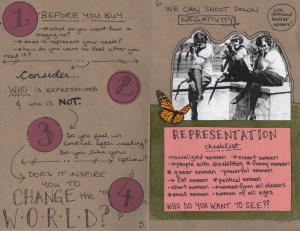
You can get involved with Media Action! The REPRESENT. Project is pretty awesome. You can download an action kit and start a REPRESENT. Club or hold a REPRESENT. Event, and you can make a three minute video about an issue regarding media representation that you really care about. The action kit is a great start up kit for people who might not know where or how to start these conversations.

Calling out is hard, and it’s definitely okay to not know how to, or to be hesitant, or even avoid it in some circumstances. I think we need to be prepared for people to be embarrassed, ashamed, or even just uneducated when they make an offensive remark. The best way to approach it is to be understanding and patient. To avoid burn out or frustration, keep in mind change won’t happen in a day, but every small action counts!

Men are already on board, and to encourage more men to engage in these kinds of conversations, I think we need to remember that men are not excluded from the maintenance of hegemonic gender roles. Not every man is a rugged lumberjack who wrestles bears for fun, not every man has a penis. That is why we need to deconstruct gender in the media to view it as fluid, so that it really has no relevance or place in media messages.

Is there a right way for women in the public eye to react to problematic media coverage/sexist interview questions?

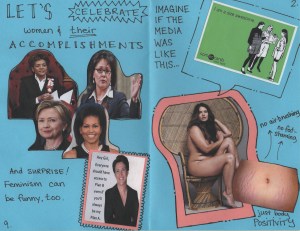
I think people like Hillary Clinton, Anne Hathaway, Amy Poehler and Tina Fey all have mastered this art, and that is to answer in a confident yet humourous way. Humour helps make ignorant people feel less attacked, but still gets your point across. For example, when asked how she felt about paparazzi taking pictures of her getting out of a car with no underwear on, Anne Hathaway calmly stated that she was sad we live in a society that commodifies the bodies of unwilling participants. Hillary Clinton, when asked about where her clothing came from, asked the reporter if they would ever ask a man that question. Or when Bill Clinton presented at the Golden Globes, Amy Poehler commented excitedly, “You guys! That was Hillary Clinton’s husband!” These types of responses make people laugh at how silly sexism and misogyny is in the media, sometimes without them even knowing what they’re laughing at or realizing that the person’s response is actually a form of resistance.

Do you agree that women in roles like news casting are held to a higher standard of youth and beauty than men? And that the seriousness of the material assigned to them is lighter?

I 100% agree with this. Even in the journalism program at Carleton, we were taught what to wear, what not to wear, how to do our make up. To be fair, so were the boys, so we have to understand that a part of being in the spotlight is making sure your makeup doesn’t shine on TV, or you’re not wearing jewelry that will reflect light. But it does go beyond that. There are some excellent YouTube videos from the 2008 democratic primaries and presidential election that illustrate not only are women in politics under attack for how they physically look, but so are female newscasters.

A big problem with news journalism is the lack of female reporters, and the lack of female experts used as sources for news stories. Informed Opinions is working with female experts to develop the skills necessary to confidently act as a source for news stories, as women tend to be more hesitant if they are approached whereas men will immediately say they can speak on a topic. It would also help to work with news agencies to ensure they are including women and gender queer individuals in their roster of potential sources. Without that initiative, we have instances like the past year’s war on women where it was mostly men discussing and determining how women’s bodies and reproductive health should be approached.

Do you think having successful women in news media like AnnaMaria Tremonte, Diane Sawyer, Wendy Mesley, etc. is a sign that things are improving? Or are they the exception?

These women are definitely role models and signs that we can take women seriously. However, if you look at it in terms of how common women like these people are in the media, then they are definitely the exception. This relates to the last question, too. Women tends to be more prominent in hegemonically feminine categories, like fashion, home improvement, or talk shows. There are way less women in hard news arenas or sports news.

I notice that on panels of experts commenting on serious issues that women often appear underrepresented. Do you agree? Why do you think that’s the case?

I completely agree. I, as well as Informed Opinions, believes this is because women are not approached and are also more hesitant to agree to be an expert news source. Women are also not believed to be capable of understanding or reacting to “serious” issues, such as the military, because of this constructed care ethic and assumption that women are nurturers and therefore too sensitive.

Do you agree that there’s pressure on women in media not to be aggressive and outspoken…and if they are — like Nancy Grace — they’re labelled as “bitches” or “ball-busters” and made fun of?

100%. And again, that is because of the construction of the hegemonic female gender role as being passive, nurturing, emotional, and sensitive. Once women step outside these boundaries, they are behaving like men, and that’s not okay. The media coverage of the 2008 US election is a perfect example of this. 

What is the role of social media? Are women themselves perpetuating the issue of poor gender image by emulating what they see in the mainstream media on Facebook and YouTube?

I definitely don’t think we can put the blame on women. Social media can be a powerful tool to build an identity, build community and networks, in addition to educating yourself and others about social justice issues. And who’s to say that women who adhere to feminine stereotypes aren’t doing so of their own choice? I think instead we need to look at how people respond to how someone presents their identity on the internet, and ask ourselves why we may respond negatively. Why do we think they’re being “bad feminists” or “bad girls”?

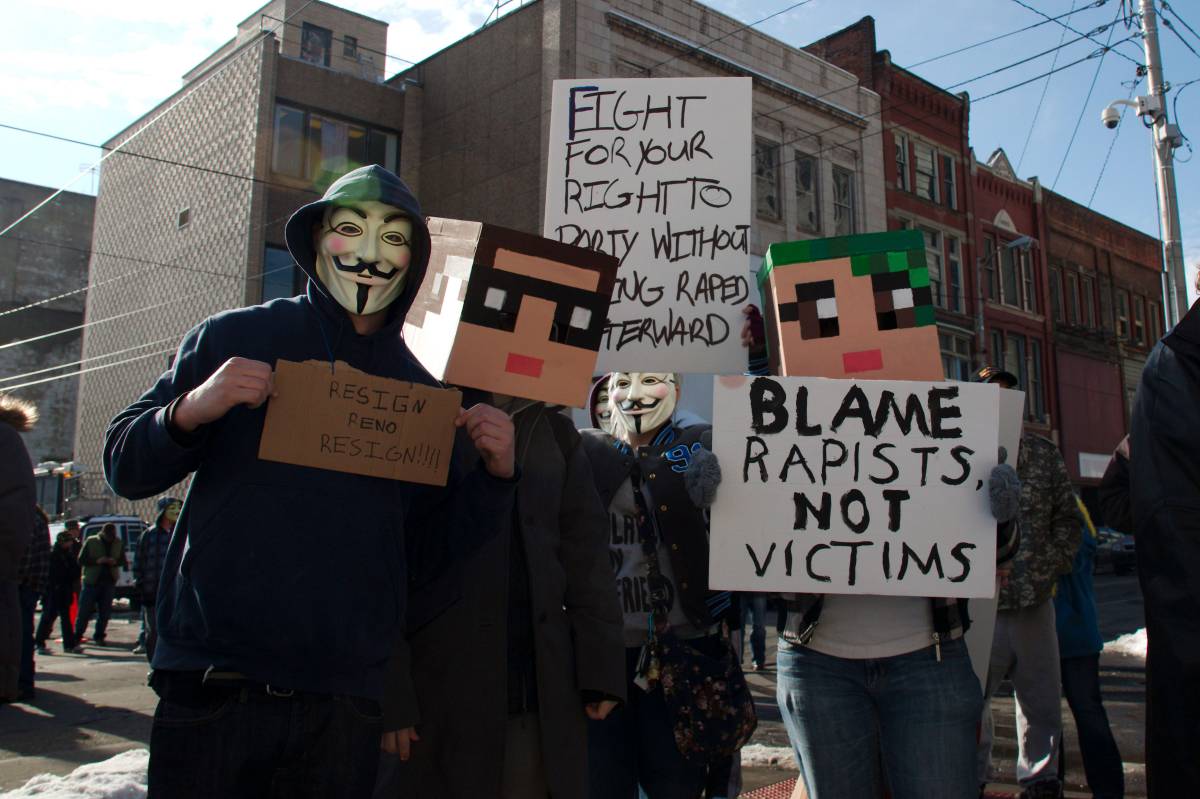
This is the last week of my Occupy Wall Street course, and so we discussed themes that the class agreed needed to be expanded upon. One of these themes was sexual violence, and in light of recent events, we contrasted the incidences in OWS compared to Steubenville.

The differences were obvious, but they still enrage me. The combination of media-framing and the journalistic rush for sensationalism rendered the OWS assaults as symptomatic of the movement itself. While of course these assaults are just as disturbing as any other, an important point to remember is that social movements do not exist outside of current systems of power and inequity. That is not to defend these events. However, it is debatable whether the number of assaults in the camps were any greater than the number of assaults that happen every day on the streets of New York City.

Thus through media-framing, the OWS assaults were picked up by mainstream media to perpetuate imagery of this social movement as violent, uneducated, barbaric and downright anarchical. This imagery was used as propaganda to promote resistance and destroy the movement.

So why is it that we refuse to frame instances of violence on school campuses in the same light?

Image

The mainstream media response to the Steubenville case has been absolutely atrocious. The perpetrators are constructed as victims of the legal system, lost football stars who were just being boys.

(See CNN for victim-blaming and justification of sexual violence due to alcohol, and emotional aggregation in support of rapists).

But everyone loves a redemption story, right? It will be interesting to see in a year from now, once they are out of prison (because a year is all the sentencing that they received), which college or university will jump on the chance to give them a scholarship and help get their life back on track. This might not even be necessary, as one of the convicted rapists is filing an appeal citing that as he is 16, his brain is not “fully developed.”

I remember two years ago sitting in an Ottawa courtroom and watching a 16-year-old boy receive over 300 hours of community service for being caught with a small amount of marijuana. I remember the shock I felt when the next individual, an older man, received a lesser sentence for beating his pregnant girlfriend, pushing her down the stairs, removing all communication technologies and her keys to their home, leaving her bleeding and bruised with nowhere to go and no way of contacting anyone.

This is how our society values women’s bodies. This is how we value the bodies and actions of young athletic men compared to those of activists, social movement actors, anarchists, fringe groups, outcasts and outliers.

216746_448010701946326_1936785569_n

Where is the redemption story for survivors of sexual violence? At the very least, where is the redemptive language in the media coverage of her experiences? The victimization of both the survivor and the rapists does no good, for anyone.

We as journalists have a degree of legitimacy and certainly a lot of power. It is our responsibility to educate ourselves and do our jobs properly. This includes not releasing the identity of a rape survivor, whose family is now receiving death threats for “ruining the lives of two young boys.” I hope that in a year from now the mainstream media will have received an education on rape culture and violence.

For an excellent response to this media coverage, check out Laci Green and her Steubenville edition of Sex+.

In my previous post, I argued that individuals from the Occupy movements were able to renegotiate power between themselves and mainstream media due to the strength and influence of social media participation. This shift in power allowed everyday people to dictate what aspects of the movement (for example, police brutality), deserved media coverage.

Power may have shifted from the mainstream media in the Occupy Movements, but it did have minor influence in regards to the behaviours of the Occupiers.

As counter-power encouraged renegotiation, the OWS media culture shifted from a top-down controlled environment to a participatory horizontal model, in which the Occupiers and mainstream media interacted with one another.

This shift to a horizontal media culture model has many explanations. Cottle acknowledges the media ecology and various flows of horizontal networks, including the compression of time and space that allows for immediate communication across geographical and social barriers. Indeed, both democracy and participation have been redefined by the relationship between globalization and communication technologies.

This new sense of democracy and participation, according to Doerr and Mattoni, virtually transcends borders, limiting the influence and control of the public sphere by traditional social institutions, like the media.

Contemporary “media environments,” they argue, “have a multilayered structure shaped by multiple flows of information and communication.”

images

That is not to say that social movements do not rely on mainstream media. Legitimacy in the realms of political institutions and conservative populations still heavily relies on coverage in traditional news media.

But the mainstream media’s impact on the Occupy Wall Street movements only went so far as defining these multiple layers as the participant responses to critical or negative coverage. Participants and their use of social media, face-to-face communication and physical embodiment of public spaces dictated media coverage, providing news material in the form of events and interviews, satisfying journalists and providing excellent B-Roll, while remaining in control of the content itself (excluding those of editorials and the New York Post, two journalism arenas that should not be included in rational discussions of mainstream media coverage).

When the mainstream media questioned the legitimacy of the OWS movement, the movement simply responded by providing more resources about their goals and aims. While participants may have altered their operations to provide clearer material or more inclusive environments, they did not produce goals and aims in response to media criticism. Rather, I would argue that was a natural progression of change and response to issues that arose throughout the movement over time.

A counter-argument to my proposal could be that media framing is unavoidable and influential. But with the influence and popularity of social media, such frames can be identified, deconstructed, and resisted by social movement actors, staying a step ahead of editors and news producers.

If the media’s primary role is to report on current events, then they are reliant on the events themselves, from which they build frames around after the fact.

Screen shot 2013-03-03 at 11.53.59 PM

One of the key components of the network society is an individual’s ability to engage in mass self-communication.

As Gerbaudo argues, social media, however influential, is simply empty boxes full of user-generated content. While there are definitely issues in regards to accessibility and hierarchies within social media, it is the people who fill these spaces that decide the course of action. Both ego networks and emotional aggregation, as previously dictated by news media, have been taken over by social media, whose producers are everyday people, including OWS activists.

Ego networks and emotional aggregation provide content to mainstream media through social media users. It is these users who determine when and how a movement will occur, defining the desired outcomes that the mainstream media can then write about.

images-1

Sources

Castells, M. (2007), “Communication, Power and Counter-power in the Network Society”, International Journal of Communication, 1, 238-266.  Available from: http://ijoc.org/ojs/index.php/ijoc/article/view/46/35

Castells, M. (2009). Chapter 1.Communication Power. Oxford: Oxford. Pgs. 10-53.

Castells, M. (2012). Networks of Outrage and Hope. Cambridge: Polity. Pgs 156-243.

Doerr, Nicole, and Alice Mattoni. “Public Spaces and Alternative Media Networks in Europe: The Case of the Euro Mayday Parade Against Precarity.” In The Revolution Will Not Be Televised? Media and Protest Movements, ed. Rolf Werenskjold, Katrin Fahlenbrach, and Erling Sivertsen. New York: Berghahn Books.

Gerbaudo, P. (2012). Tweets and the Streets: Social Media and Contemporary Activism by Paolo Gerbaudo.  London: Pluto Press.

Juris, J. (2012). “Reflections on #Occupy Everywhere: Social media, public space, and emerging logics of aggregation” American Ethnologist, Volume 39, Issue 2, pages 259–279, May 2012.

McCurdy, Patrick (2012). ‘Social Movements, Protest and Mainstream Media’ Sociology Compass 6(3): 244-255

Koopmans’ argues that the relationship between social movements and political authorities is determined by mass media coverage. Koopmans’ theoretical framework suggests that these authorities, including police or politicians, react to a social movement according to how it is depicted in the media. Activists change their strategies according to media coverage in an effort to increase their visibility, resonance, and legitimacy in the public sphere.

This framework gives most of the power to the mass media (the gatekeepers), and lessens the power of the activists (the speakers).

However, the Occupy Wall Street movement used a number of tools to renegotiate power between itself and mass media.

As seen in the documentary Fault Lines – Occupy Wall Street: History of an Occupation (which you can watch here), OWS used live streaming as a tool of resistance. One activist argues that “having a live stream allows nothing to be hidden and shapes the narrative.”

OWS activists thus not only renegotiate power, but they also use new media to increase their legitimacy within the public sphere.

This is an important tool. Higher legitimacy could create more public demand for increased coverage of events like police brutality in social movements. Like a domino affect, these issues are hard to neglect or deny once activist videos go viral.

This reveals how the mass media may alter its behaviour according to that of social movement actors, and not the other way around.

images-1

For example, this renegotiation of power is evident in the public backlash caused by citizen journalism during the 2010 G20 Summit in Toronto. The large number of videos posted on social media, like Facebook, Twitter and YouTube, increased the public’s understanding of police brutality towards peaceful protestors.

The mass broadcast media largely depicted the police responses during this event as necessarily premeditated. However, the citizen journalism available gave voice to those who had been unjustly assaulted and arrested for exercising their right to peaceful protest. This material gave power to otherwise silenced voices in the mass media, and contributed to the investigations that occurred after the Summit was over.

Castells offers a theoretical framework that includes the counter-power I have described above. Castells argues that the diffusion of communication technologies and social media have prompted the development of horizontal networks of communication. This has redefined the public sphere to accommodate counter-power.

Social actors, like activists or citizen journalists, engage counter-power to oppose existing institutions, such as mass media or political authorities. Contemporary counter-power is largely the result of social media and the increasing accessibility of communication technologies, which has created mass self-communication. As one person can now send out information on a large scale, Koopmans’ theory of media power holds little ground in Castells’ understanding of counter-power, social media, and communication networks.

The sites of power in Castells framework include public opinion, as social media is a tool used to change or influence a population.

images

There is a consistent reality regarding social activism throughout these discussions: in order to generate and maintain support, those who do care or are interested in generating support for a specific cause, need to make it very accessible and easy to get involved.

After all, public opinion can be a very powerful thing.

We cannot deny the incredible influence of social media in terms of ease of involvement and quick spread of ideas. While this may be linked to questionable social behaviours (such as slactivism), public behaviour, in whatever form, is still powerful.

Consider the Kony 2012 campaign. The success of this movement, including its resonance and incredibly large amount of supporters, was directly related to how easy it is to click ‘share’ and literally spread not only information and ideas, but also to encourage independent action regardless of location.

What the mass media reported on, at least in the beginning of Kony 2012, was the mass number of people who were participating in the social media awareness campaign. Their behaviour dictated media coverage.

Juris brings up an important point when discussing the power of social media: not everyone has access to it. However, while the mass media may be more prevalent than social media for some populations, I find it difficult to theorize that, in 2013, the behaviour of the mass media will have an impact on these populations while social media will not.

Today, social media and mass media are more often than not intertwined. Journalists are alerted of events, correspond with citizens and find sources on social media like Twitter, and even include public opinion in their broadcasts and articles, citing social media as a source.

Thus media power, in all of its forms, is now partly defined by its relationship with social media and the actors involved in these new networks – the people.

Continue reading


On New Year’s Eve I remembered a game I played in Kenya in 2010. First, we were told to list all of the things we had in our bedrooms that we used to represent ourselves. Next, we were asked to list every item in a rural Kenyan household.

The first compilation of lists included pictures, paintings, trinkets, CDs, clothing, and jewellery. The second included matches, cookware, and maybe a blanket.

The lesson I learned from this game was one that rang true throughout the whole trip and back home: True self expression is defined by what we do and who we are to others, not by what we have.

I’m not a fan of resolutions but I am a fan of self-reflection. My goals for 2013 include defining myself through what I can do for others, the active memories I hope to make, and the things I will do.

One of the projects I’m looking forward to is the REPRESENT. project. You can read more about it here.

Wondering if media representation is still important? Check out the video posted here, for how women (especially politicians), were talked about in the media in 2012.


Grad school has been exhilarating and stressful. It has taught me a lot, and has served as an avenue to express what I already know. Today was the last day of my feminist theories class, and all of my classmates presented their research and work from the past four months.

Every project was fascinating, and it is both overwhelming and inspiring to think about how many stories there are in the world left to be studied and told. Some of the highlights from this class include:

D’s autoethnography which discussed issues of race and class. One point that struck me was the concept of “horizontal hostility” – ‘rednecks’ pridefully viewing themselves as ‘original settlers,’ which distances them as a group from exploited social groups, while being exploited within larger social systems. It is interesting to think about how race can render economic exploitation invisible.

N’s project on discourses surrounding FGM versus western cosmetic surgeries discussed how immigrant bodies are viewed as having been “mutilated.” This made me wonder whether transwomen’s bodies, those that have surgically transitioned, are also seen as “mutilated” bodies, and what the consequences of such a label would be.

M’s project about femme invisibility in lesbian imagery raised important questions regarding “genuine lesbianism,” which is seen as the “butch dyke,” often deemed to be of working or lower-class. This made me think about notions of citizenship, and how citizenship and “genuine lesbianism” are conflicting ideology when you look at it from a critical class perspective.

I’m happy to say that both my courses and my classmates have challenged me to think critically about feminist topics and social issues, and I’m already looking forward to next semester!