Eternal Sunshine of the Spotless Mind is quite possibly one of the most raw and beautiful movies I’ve seen. I can’t believe the film is 10-years-old this month, but this blogger put together the best playlist to celebrate. (Bonus: the first song is “Riptide” by Vance Joy – a current favourite!)

I hope you never get a Lacuna Inc. message in the mail saying someone erased you. We can’t help who we love and I hope you have or find this rare form of love. And I hope you celebrate the movies that change lives and live on forever. Re-watch/check out the movie, enjoy the tunes and maybe one day I’ll meet you in Montauk.

Check out the playlist here.

In the increasing absence of local, personal forms of fellowship and solidarity, he suggested, people were naturally drawn to mass movements, cults of personality, nationalistic fantasias. The advance of individualism thus eventually produced its own antithesis — conformism, submission and control.

You don’t have to see a fascist or Communist revival on the horizon (I certainly don’t) to see this argument’s potential relevance for our apparently individualistic future. You only have to look at the place where millennials — and indeed, most of us — are clearly seeking new forms of community today.

That place is the online realm, which offers a fascinating variation on Nisbet’s theme. Like modernity writ large, it promises emancipation and offers new forms of community that transcend the particular and local. But it requires a price, in terms of privacy surrendered, that past tyrannies could have only dreamed of exacting from their subjects.

Read more here. 

When I was doing research for my book “Monster,” I approached a white lawyer doing pro bono work in the courts defending poor clients. I said that it must be difficult to get witnesses to court to testify on behalf of an inner-city client, and he replied that getting witnesses was not as difficult as it sometimes appeared on television. “The trouble,” he said, “is to humanize my clients in the eyes of a jury. To make them think of this defendant as a human being and not just one of ‘them.’ ”

I realized that this was exactly what I wanted to do when I wrote about poor inner-city children — to make them human in the eyes of readers and, especially, in their own eyes. I need to make them feel as if they are part of America’s dream, that all the rhetoric is meant for them, and that they are wanted in this country.

Read more here. 

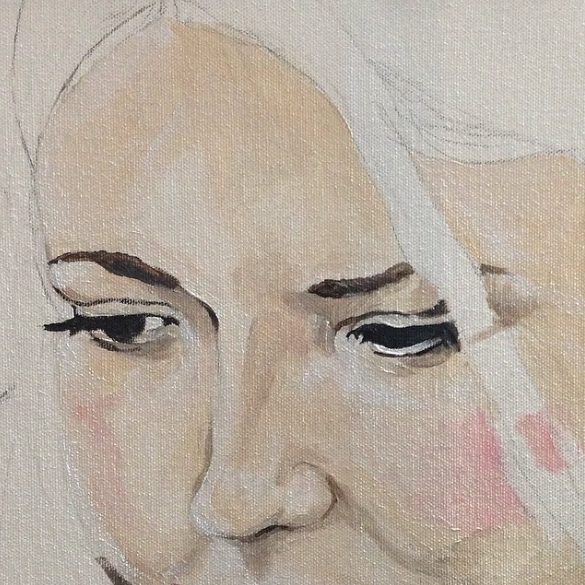
I’ve been trying to indulge in some of my creative passions lately, with the goal of developing a career as an artist. Here’s a sneak peek of a portrait I’m working on to use as the header for a site I’ll be launching soon. Keep your eyes peeled for what’s to come!

Screen Shot 2014-03-11 at 4.30.44 PM

The other day, I came across an article that helped soothe my anxieties about trying to build a life as an artist. Anyone else struggling with the stress/anxiety/guilt/fear of what they’re supposed to be doing right now or how to make some kind of artistic vision “happen,” might benefit from reading this as well.

What happens when you can’t stop drawing? Sometimes you can’t even start, but stopping is not a possibility. What happens when the little girl you were, who locked herself in her room to draw for hours finally catches up with you? You open the door, you let her in and promise her you won’t let her down ever again. — France Belleville

Conservatives blame the media-hyped “epidemic of obesity” on failures of individual will, while liberals point to McDonald’s, high-calorie school lunches, and sedentary jobs. But it’s unlikely that any of these factors is making us fat. After all, thin people watch television and eat fast food, too, and fat people have never been proven to consume more calories, or more “junk food,” than others. And as numerous excellent books have demonstrated (see Paul Campos’s The Diet Myth and Gina Kolata’s Rethinking Thin for detailed explications of some of the scientific information presented in this article), we are not in the midst of an “epidemic” of fatness. Since 1990, Americans have experienced an average weight gain of about 15 pounds. Hardly cause for alarm, especially since this modest increase in our collective size may be a good thing: A decline in smoking rates could be a factor (quitting smoking typically results in weight gain), as could the increased popularity of weight-lifting and other muscle-building exercise (statistics on “obesity” are based on BMI charts, which classify Matt Damon as “overweight” and Tom Cruise as “obese”).

Nor is fatness, as conservatives often claim about homosexuality, a “lifestyle.” Body size is determined primarily by genetics, and while diets and exercise programs may produce short-term weight loss, they have a 95 percent failure rate over the long term. Yet like queer people living with hiv or aids, fat people are stigmatized for a condition that is imagined to be their fault. They are hectored by conservatives such as Mike Huckabee, mocked by liberals like Jon Stewart (who, of course, would never dream of making lesbians or gay men the butt of his jokes), harangued about their weight by medical professionals, and subjected to a barrage of advertisements promising “cures” for their supposed disorder.

Does this sound familiar? Remember psychiatry’s attempts to cure homosexuality? Our culture’s hand-wringing over the “obesity epidemic,” its hawking of one breakthrough diet or miracle weight-loss product after another, and its moralistic shaming of those it deems “too fat” are as conducive to self-hatred as “gay conversion therapy.” But while the harmful conversion therapy that religious conservatives practice on lgbtq people has rightly been the target of political protest and legal intervention, the medically sanctioned use of weight conversion therapy (a.k.a. dieting) has provoked far less outrage on the Left. Let’s Move, as McCrossin observes, is essentially “a child-focused, government-sponsored fat version of conversion therapy.” If we would ban the use of gay conversion therapy on children (a practice now condemned by the American Psychiatric Association), then why do we foist similar programs on fat children—subjecting adolescents, most recently, to the humiliation and health risks of vying for the title of the Biggest Loser?…

… Clearly, the politics of homophobic hate are inseparable from our culture’s fear and hatred of fat people. The slur “fat, ugly dyke,” used to police women of all sizes and sexual orientations, exemplifies the deeply rooted intersections between fatphobia and homophobia. Sure enough, a new federally funded study plans to determine why lesbian and bisexual women and girls are among the “hardest hit” by the “obesity epidemic.”

Read more here. 
I was doing research for one of my passion projects and came across this article.

Let them eat kale… It’s hardly reasonable to demand that every woman who wishes to better her life be poor, or nonwhite, or in some other way representative of diversity in order to be taken seriously. But Eat, Pray, Love and its positioning as an Everywoman’s guide to whole, empowered living embody a literature of privilege and typify the genre’s destructive cacophony of insecurity, spending, and false wellness…

… Eat, Pray, Love is not the first book of its kind, but it is a perfect example of the genre of priv-lit: literature or media whose expressed goal is one of spiritual, existential, or philosophical enlightenment contingent upon women’s hard work, commitment, and patience, but whose actual barriers to entry are primarily financial. Should its consumers fail, the genre holds them accountable for not being ready to get serious, not “wanting it” enough, or not putting themselves first, while offering no real solutions for the astronomically high tariffs—both financial and social—that exclude all but the most fortunate among us from participating.

Source. 

One interesting, under-reported trend in modern cinema is the increasing prevalence of the female documentarian. Whereas the statistics for female directors in Hollywood at large are predictably depressing, with only three wide-release movies in 2013 directed or co-directed by a woman, women are quietly producing incredible work in the documentary sector. In my home country (the UK) we’ve recently seen powerful, original, brilliant work by Carol Morley (Dreams of a Life), Jeanie Finlay (Sound It Out), Clio Barnard (The Arbor), Beeban Kidron (InRealLife)… seriously, if you wanted to use this post as a set of NetFlix recommendations, you wouldn’t be disappointed.

Want evidence of how accepted and respected female directors have become in the documentary sector? The Directors’ Guild of America, an organisation that you will be surprised to learn is a guild of American directors, just published its list of nominees for Best Documentary. They include two men – Joshua Oppenheimer (The Act of Killing) and Zachary Heinzerling (Cutie and the Boxer) – and three women. The actress Sarah Polley’s film Stories We Tell, about discovering an old family secret, is the most high-profile film on the list, but there’s also Jehane Noujaim’s The Square, about the unrest in Egypt, and Lucy Walker’s extreme sports film The Crash Reel.

A surprise omission, and one that I suspect the Oscars will honour, is Blackfish, the film exposing conditions at SeaWorld. That one was directed by Gabriela Cowperthwaite. A woman? Uh huh.

Source.