I read an article before leaving for Rwanda that stated people become more conservative as they age.

I laughed when I read that.

Personally, I couldn’t see myself, or at least my values, changing that much. I understand that as you undertake more responsibilities – a mortgage, a family, car payments, saving for retirement – you become more protective of your money and possessions.

You become, well, more responsible.

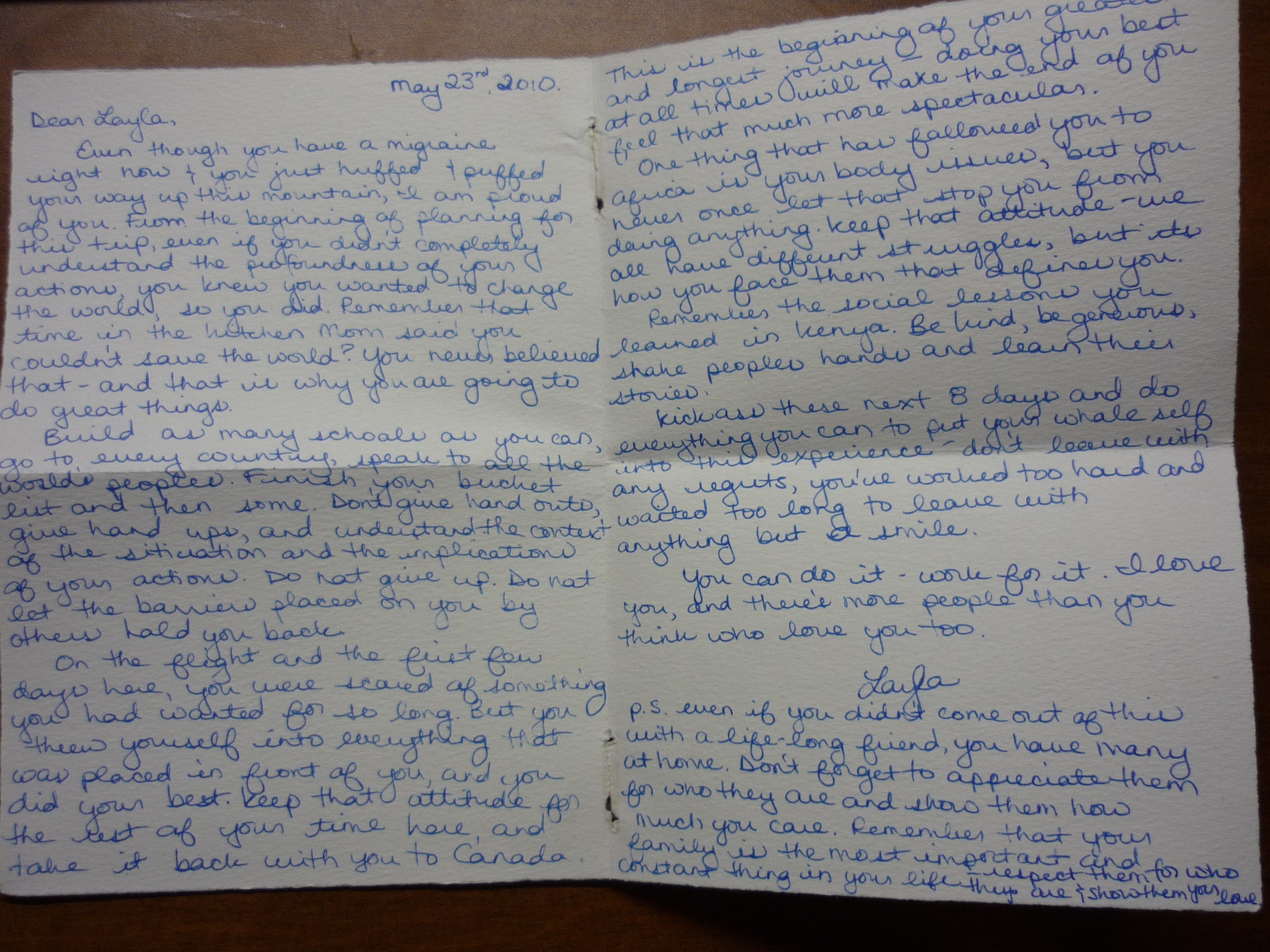
I’m not saying I’m not responsible, but I’ve always believed that fun can still exist in taking calculated risks. However, as I read on, I still couldn’t imagine myself becoming that uptight, or my dreams straying far from what they have always been: to travel to every country in the world, to explore, to be spontaneous, to tell stories.

To invest in adventure.

I have always loved to travel. I can usually be found looking for flights to plan my next trip, packing in as much as possible and trying to see all the surrounding countries from where the plane would land.

After my first few days in Rwanda, the shift from reckless adventure to conservatism is something I haven’t been able to get out of my mind, and is something that has contributed greatly to my initial anxiety. It is something I am definitely struggling with.

It is hard to explain how stressful traveling is, especially with valuable equipment that, as a student, I could not afford to replace if it were stolen.

This stress is exhausting, but it also makes you feel like a privileged western troll whose main concern is guarding its precious treasures.

I have been polite, enthusiastic and energetic, but I don’t like how I have been thinking.  I do not feel like the unafraid, excited, and adventurous journalist I have always believed I was.

Because I do not completely trust leaving anything at home, and because there is nowhere to lock my pelican case in my room (which I brought two cables and two padlocks for), I’m trying to keep my laptop, camera, travel documents and passports in addition to anything else I need for work, with me at all times.

Yes, my arms will probably be jacked after this trip, but to be on constant watch of where your bag is, to sound whiney, is kind of annoying.

To be skeptical of my surroundings, especially in a developing and proud country, and considering that I am incredibly lucky to even be able to afford any of this equipment, makes me feel like a total prick. The kindness and generosity of my landlord, his family, the staff of both our home and our work, all of whom I do trust, heighten these feelings of guilt.

However, we have been warned by many people to still take precautions regardless of who is around. After all, once it’s gone, it’s gone, and you’re a pretty useless journalist without it.

This trip is certainly a reminder of what is important, and what you really need to survive, be happy, or do your job. Packing was the first step; limited to a certain weight, your luggage is only filled with the bare necessities. Plus, you’re carrying it all, so you want to ensure you travel light.

And of course, as with any expensive trip, and as a student, I must be somewhat conservative with my money to make sure I can make it through to the end with enough to eat and a place to sleep.

But I haven’t figured out how to balance adventure and work without risking losing it all, or losing valuable cultural experiences.

What is scaring me the most, so far, is that I doubt ever doing another professional trip like this again.

It is different to travel as a tourist, and I would argue much easier. For example, tourists don’t usually stay in one place for two months. Having to live abroad requires more equipment and more packing, which means there is more to lose.

I’m worried that perhaps the article I read was right. Maybe as we grow up and embark on our own adventures we learn that it really isn’t as simple as buying a plane ticket and getting to the airport on time.

Maybe our dreams weren’t as simple, or realistic, as we thought.

There is careful planning involved, months of preparation, and many costs, including travel outside of the airfare, accommodations, and utilities, all of which are also being paid at home and going unused.

I hate that I’ve been thinking like this. I want to go back to being an adventurer, as naïve as it was.

But I don’t think I can, and that scares me.
Today I saw “Welcome to the Machine,” a documentary that looks at the impact of technology on human life and delves into discussions about the future of technology and society.

Most importantly, it begs the question: how far is too far?

The film was very well done, interspersed with clips of old and new technology, discussions of past developments and those planned for the future. Many discussions revolved around robots that may express emotions similar to humans; one subject argued that humans themselves are machines, quite literally controlled by chemical reactions in the body that thus must lead to the creation of emotion, which would theoretically then be possible to develop in artificial intelligence.

Many of the subjects, including professors from MIT, authors, philosophers and culture critics, were optimistic about the advancement of technology and its impact on society.

One subject put forward the idea of having tiny mobile devices the size of cells, thousands of which could be put into your blood stream, allowing you to do things like “Google” information from your brain and spew out research seemingly from your own mind.

The more optimistic side of the debate sees technology as a natural progression and extension of our selves.

The film artistically contrasted scientific history as well as Biblical history to show both the optimistic and pessimistic sides to converging technology and humanity. While much advancement has made life easier, historically departing from nature as been viewed as sinful (for example, Adam and Eve sewing clothing).

Some argued technological developments would lead to the end of the human race.

The film asks, “Will humans just become the machines that run the machines?”

The director argues that you cannot restrict some technologies and not others – maybe restrict access, but not the development of technologies, which complicates methods of control.

The film followed three stories: the director’s experiences with IVF and the birth of his triplets; a blind lawyer undergoing experiments to regain his vision; and the US military operating unmanned aircrafts to save both time, money, and human life on dangerous missions.

Interestingly enough, the director saw technology as a good thing in the early stages of making this film. Despite undergoing IVF later on in the filmmaking process, which led to the birth of his triplets, the director said that by the time the film was finished, he held a pessimistic view of technology.

The film discusses the lengths to which society could go to preserve its humanity.

While some argue that technology cannot be stopped, the director converses with Dr. Theodore Kaczynski, also known as the “Unabomber,” who sought violent efforts as a way to discourage technological development. He wrote “Industrial Society and Its Future,” also known as the “Unibomber Manifesto,” arguing that humans were less free with the inclusion of more technology. Inherently, Kaczynski sees the technological system as a hole that needs to be destroyed to create a society that is less dependent on technology.

(Ironically, he is being held in one of the more technologically advanced prisons on the planet).

I felt uncomfortable during the film. I had never thought about how far technology would develop or the theories behind the relationship between technology and humanity, (although I have always used technology at a pretty basic level).

The director states at the end of the movie that, in life, “you can’t take the batteries out – you only have right now.” That sense of urgency, of life, of having only a moment and then losing it to history forever, is a feeling that I believe no artificial intelligence or piece of technology could ever understand.

Then again, I took notes on my Blackberry after the film and typed up my thoughts to be shared on the Internet, so who am I to talk?

On my way home tonight, I came across this article published by the Ottawa Citizen entitled “Don’t go to Africa ‘to help’”. I spent today thinking about the next ten years of my life, years that I hope will include lots of travel, and was enraged by this article to the point where I paced back and forth on the dock for 15 minutes trying to understand what I was thinking and feeling.

To read the words: “Don’t spend six months travelling Africa. Don’t bike across Canada to raise awareness about world hunger. Don’t go to Cambodia to volunteer at an orphanage. Stay put and work on fixing problems at home, including your own,” made me feel uncomfortable as I am preparing to embark on a trip to British Columbia and a two month journey to work for a magazine in Rwanda, followed by traveling for almost a month to many destinations throughout Africa and Europe.

I don’t think we should criticize those who live outside the box. I acknowledge that traveling is often a privileged activity. This doesn’t mean we should discourage anyone from seeking information or methods of organizing some kind of adventure within their means.

Quite often when people travel, whether for pleasure or volunteer work (or both), they find that their problems really are not that significant. That right there is a viable solution to working on one’s problems. Not everyone dreams of staring at the inside of a cubicle and coming home to a small apartment, only to pass out with a lap full of takeout on their Karlstad leather couch from IKEA.

This piece suggests that travel involves either life experiences or volunteer work, both of which, it states, are inherently selfish. Yes, I found that many people I have worked with overseas had no understanding of the context, history, or political situations of the communities we were working in, but were there to take pictures, return home, and make Facebook albums of them smiling with African children and trying to look like the next Mother Theresa, only to resume their individualistic lifestyles they had when they left upon their return to Canada.

But many people came home and did not run to their laptops. They sat down with their families and told them about communities they had never heard of. They took shorter showers, started drying their clothes outside, bought locally produced food, stopped buying bottled water, campaigned for causes they believed in – whatever social issues that had impacted them, they worked on.

Life experiences are what make living worth it. Living in a bubble can fulfill some people. For others, it does not, and they can increasingly fulfill their desire to see the world as our societies and technologies continue to develop. Volunteer work can be convoluted, but what is neglected within this article is that volunteer work is a two-way street, and having both parties benefit is not a bad thing.

One party will likely develop economically, or socially in terms of health care, housing, or education. The other party develops on a personal and emotional level. If I was to ‘quit my internship and start a business that’s better than the one that wouldn’t give me a job’, I would not hire those with a resume filled with jobs within a ten-block radius of their apartment (or, in realistic Toronto-terms, from their parents’ basements).  To be building a more compassionate, worldly generation, you need people with these ‘life experiences’ to bring these memories to the table. We need to value these experiences back at home.

Traveling to Kenya changed my life. It changed me because I could see, experience, and learn about sustainable positive development (and no, I did not blindfold the children I worked with and hand them a Bible).  I could give a hand, and not a hand out, by actually being there.

It is true that the Kony 2012 campaign revealed the “white savior complex” and number of slacktivists there are. No, liking a Facebook pages does not make you an activist. Yes, it is true some generations (or some people) are selfish. There are many valid counter-arguments to this oversimplified campaign (it’s ineffective, inaccurate, not sustainable, etc.), but it did something to the slacktivist generation.

The first step to social change is to generate excitement and awareness – how to maintain social change is another story. However, communications classes will study the Kony 2012 campaign for years to come, and maybe one day we’ll have an answer as to how we can maintain enthusiasm. Travel is one solution I can think of.

Of course there are social issues in our own communities, and of course we should extend a hand to those around us. Extending a hand to those abroad will also help our communities become composed of compassionate, worldly, and knowledgeable people. More people will know what it means to truly be human and experience life, rather than robotically walk through our own institutions and systems.

Maybe I would rather spend my money on seeing the world, and not just the inside of the house I could spend my travel fund on. Does this idea sound romantic? Sure.

But we need to learn to hold romanticized adventures on a higher level than mundane existences that simply exist to make money. Maybe then we’ll find freedom from our ‘boring jobs’ by coming home with the experiences, knowledge, and vision to create sustainable, culturally sensitive initiatives.

Our problems should not include figuring out how to buy a big house to live in. Maybe with some travel experience, we’ll know what it truly means to live.

There are definitely corrupt organizations, and traveling without educating yourself first is a waste of time. But where do you think the people who run organizations abroad started from? To sit back and do nothing, to encourage complacency in an already self-centered society, will do nothing but maintain social injustices and ignorance across the board.

Image

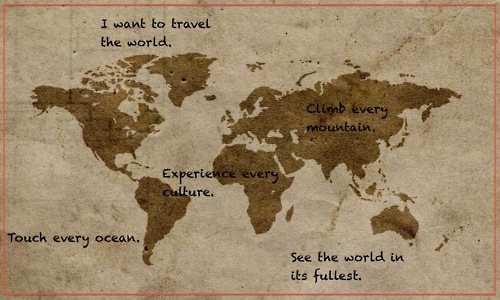
In Kenya, in May 2010, we were told to write a letter to ourselves. We received them unexpectedly in the mail almost a year later. While this is probably one of the most personal things I’ve ever written (most likely because it was to myself for my eyes only), I found it today and find it to be the best reminder I could have asked for in such a transitional time.

May 23, 2010

Dear Layla,

Even though you have a migraine right now and you just huffed and puffed your way up this mountain, I am proud of you. From the beginning of planning for this trip, even if you didn’t completely understand the profoundness of your actions, you knew you wanted to change the world, so you did. Remember that time in the kitchen Mom said you couldn’t save the world? You never believed that – and that is why you are going to do great things.

Build as many schools as you can, go to every country, speak to all the world’s peoples. Finish your bucket list and then some. Don’t give hand outs, give hand ups, and understand the context of the situation and the implications of your actions. Do not give up. Do not let the barriers placed on you by others hold you back.

On the flight and the first few days here, you were scared of something you had wanted for so long. But you threw yourself into everything that was placed in front of you, and you did your best. Keep that attitude for the rest of your time here, and take it back with you to Canada.This is the beginning of your greatest and longest journey – doing your best at all times will make the end of you feel that much more spectacular.

One thing that has followed you to Africa is your body issues, but you never once let that stop you from doing anything. Keep that attitude – we all have different struggles, but it’s how you face them that defines you.

Remember the social lessons you learned in Kenya. Be kind, be generous, shake peoples hands and learn their stories.

Kick ass these next 8 days and do everything you can to put your whole self into this experience – don’t leave with any regrets, you’ve worked too hard and waited too long to leave with anything but a smile.

You can do it – work for it. I love you, and there’s more people than you think who love you too.

Layla

p.s. Even if you didn’t come out of this with a life-long friend, you have many at home. Don’t forget to appreciate them for who they are and show them how much you care. Remember that your family is the most important and constant thing in your life – respect them for who they are and show them your love.

Image